

Joanna Penn had read Write for Money and Power before we recorded, and the first thing she wanted to talk about was one word in the title. Power. She’s been writing books for 20 years, and she said she’d never seen another writing book use it.
So that’s where our episode of The Creative Penn Podcast starts: why a writer would want power in the first place. Writers get told we’re not allowed to want it. We’re supposed to be starving artists, grateful for anything that comes our way because we get to make our art. When I was coming up in Hollywood, all of us were being funneled into the gatekeepers’ vision for our careers, and that meant handing over our power. The book is about taking it back.
Joanna was one of the original indie authors, back when self-publishing was still called vanity press, so this was a fun one. Here’s the full episode:
It’s also on Spotify, and Joanna’s show notes and a full transcript are on her site.
👑 From starving artist to creator CEO
I never wanted to be a business person. No spreadsheets, no accounting. But if you want a say in what your cover looks like, how your book is marketed, and when it comes out, that comes with the rest of running the business.
Here’s what made it worth it to me. Sell a book to a reader who likes your work, and your royalty can go from 10, 20 or 30 percent to as much as 70 percent, because you took on the CEO cap. The number of books you need to sell to have a beautiful life as a writer drops immediately. And instead of waiting two years for a book to come out, I wait six months and pick exactly how it enters the world.
🔁 The 3 income streams that feed each other
The income streams in Write for Money and Power are my own: freelancing, a paid newsletter, and book royalties. What I love about this trio is that each one funds the next.
A paid newsletter audience pays a subscription, then buys your book the day it comes out and becomes your early readers. That community is the proof point for your freelance services (so many novelists I know offer developmental editing on the side). And the freelance money funds your next book launch, or buys you more time to write here on Substack.
It’s an alternative to the day job we’ve all assumed writers need. And unlike a following on Instagram or TikTok, you keep every email address and take the list with you from platform to platform.
📖 The serial math, and the readers it built
When you sell a single book, you’re usually making about $6 to $7 of profit, depending on how you publish. A Substack priced at around $8 a month out-earns that the moment a reader stays subscribed past the first month.
The math is why I started serializing Let Me Be Your Ghost here on Sutoscience. What surprised me is who showed up. Readers have emailed me since the first chapters went out, telling me what they loved and what they’d change. They’ve found me beta readers, championed the book to their friends, and were first in line when preorders opened. I’m serializing what is essentially a rough draft, and thousands of chapter views later, those readers are helping me make the finished book the best it can be.
🧭 Getting traction from zero
Joanna pushed back, fairly. A lot of writers are arriving on what is now a crowded platform, posting a few chapters, and finding nobody there. Here’s what I told her.
Most of my subscribers, paid and total, come from Substack itself. Recommendations, the algorithm that suggests you when someone subscribes to a similar publication, the category pages. I don’t pay a cent upfront for those readers. Substack takes 10 percent of every paid subscription, so its incentives line up with mine, and it keeps building tools that send readers my way.
So make sure your publication is categorized correctly, go on other writers’ Substack Lives and host your own, and show up where discovery actually happens. Fiction is still a smaller category than personal essays and how-to, but it’s growing, and you get discovered alongside the journalists and novelists who give this platform its serious reputation.
🔇 Everything else is noise
Joanna doesn’t like chatting in comments, and I get it. It can be overwhelming to feel like you have to be on every platform, present for everyone who has access to you. Substack is one more place where you have to decide what’s right for you and what isn’t. I’m very rarely on Notes. I schedule ahead and don’t engage a whole lot, and I’ve still met the most fascinating people in real life through connections I made here.
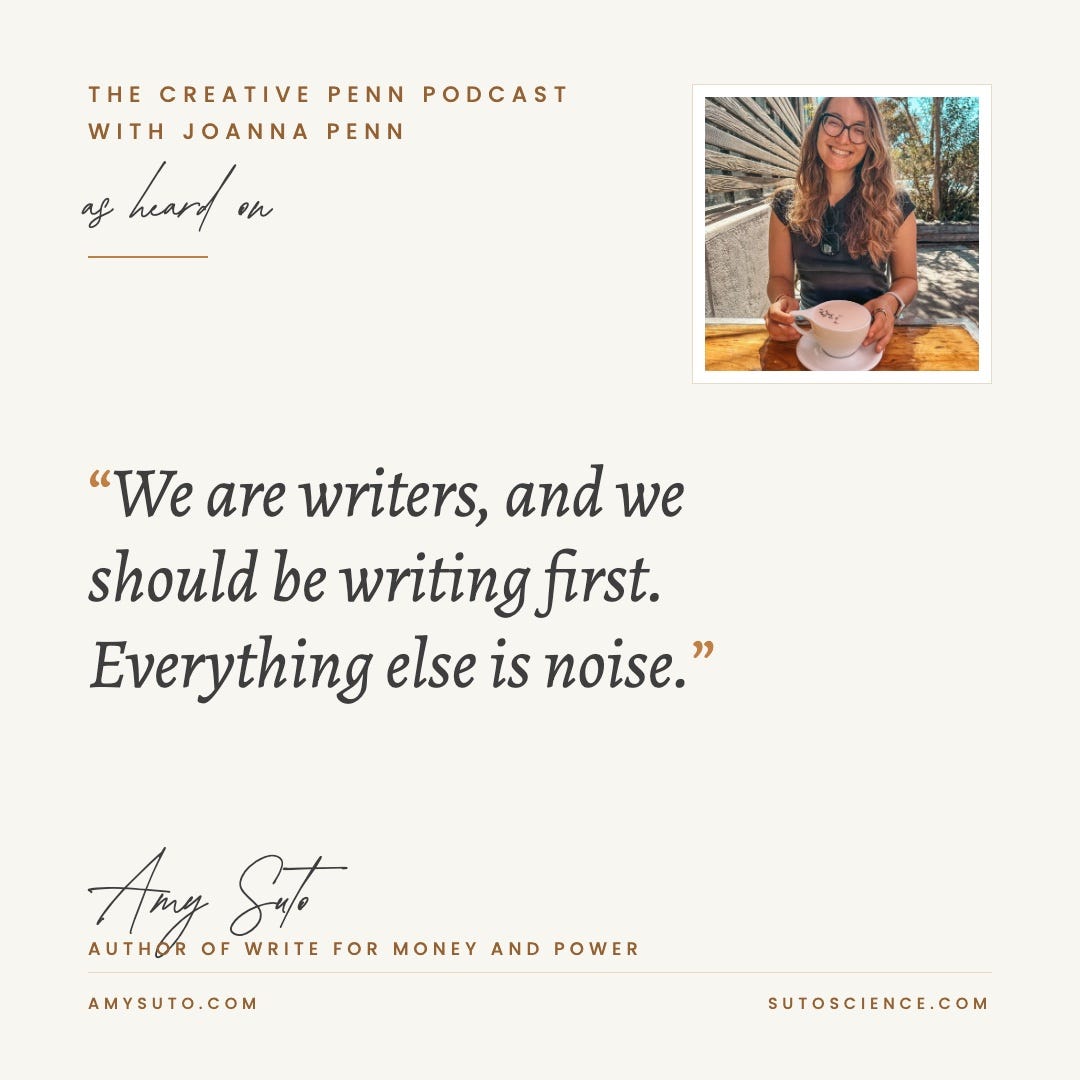
The test I keep coming back to: we are writers, and we should be writing first. The platforms and the tools are only worth it if they buy you time to write work your readers will love. Everything else is noise, and the question to ask about any feature is whether it gets you closer to your true readers or just eats an afternoon.
✂️ Using AI like a scalpel
Joanna quoted my book’s AI chapter back to me, so we got into it. The way I think about it: in Hollywood, a showrunner brings together a room of 5 to 8 talented writers, bounces ideas off them, and everything still goes through the showrunner’s computer last. In traditional publishing, your editor, your agent and your publisher all shape the book. Writers have always had a room.
For me, AI takes the tedious parts of that room. Did I already use this anecdote? Here’s a 30-minute transcript of me talking through a chapter, help me shape it into something I can edit. You used the word “temperature” 37 times in the last six chapters. What was the name of that small town in wine country? Can you track this character’s eye color across the whole book, because I changed it five times?
It surfaces what a good editor would surface, and it will absolutely not replace my editors. I told Joanna I’d just put in a big order for red pens, because I need the analog experience of a printed draft at a coffee shop, writing in the margins. It’s still the author’s responsibility to sit down with the draft and have their hands on every single word before it goes out. We’re writing for other humans. Professional writers wield these tools like scalpels, and the slop epidemic is the opposite of that.
🎧 Also in the episode
The spy show I was writing with a CIA agent when I decided to leave Hollywood, and how my digital nomad years turned into The Nomad Detective
Start with the thing you’re most excited about: the sci-fi author who wrote a whole piece on which fountain pens survive an airplane, and why in the niche comes the universal
Why I run two Substacks, and what ✍️ Make Writing Your Job does that 💡 Sutoscience doesn’t
How I bridge audiences, like telling my nonfiction readers about a romantic thriller inspired by my memoir ghostwriting work
Joanna’s own use case: asking Claude where her heroine would still be hurting in the fight scene of ARKANE book 14
🌱 Want help growing your own Substack?
The discovery tactics above, from categories to Lives to what goes behind the paywall, are what I teach in the 6 Week Substack Sprint, my workshop series on the formats I see working on the Substack bestseller lists. It comes with a Sutoscience Founding membership, along with our monthly Substack Lab calls, where you bring your Substack and get live feedback on growing it.
Thank you to Joanna for the conversation, and for reading the book so closely. I told her on air how much I love that she covers the mechanics of bookselling on her show and her blog, and I meant it.
-Amy
P.S. Let Me Be Your Ghost comes out November 18. Preorder a copy in any format and I’ll send you my unpublished guide, How to Write a Memoir, for free. Preorder here.