

Business Insider wrote about my Substack this month, which is fun and ~ mildly terrifying ~ when your relatives start texting “saw you on my newsfeed today” in the tone of people who have just seen a mugshot.
The piece was about the money: multiple six figures a year from a newsletter that started at $0 in June 2023, without paid ads.
What it didn’t have room for is the other half of my week, which I spend inside other people’s Substacks. Audits. Our monthly Substack Lab calls with Founding Members. The occasional 2-week sprint with a client. And after enough of those, I can open a publication cold and usually tell you what’s wrong by the second scroll, because it’s one of the same 8 things, and because I have personally done all 8.
Here’s the hot take, and then I’ll be nice:
There are writers who are not as good as you who are earning more than you on this platform.
I’m not being cute. I’ve read their stuff. They’re out-earning you because they market better than you, and marketing is a creative skill, which means you can learn it.
The catch is that you have to learn it without it eating into your writing time, and almost nobody teaches it that way. (I’m teaching it that way in a workshop next Tuesday. More on that at the end.)
So consider this a wake-up call. A cozy one. I brought matcha. 🍵
📝 A short quiz before we start
One point each. Be honest, nobody’s watching:
You’ve renamed your Substack more times than you’ve posted on it.
There’s a Notion doc somewhere called “Substack strategy.” It was last opened in March.
Your most recent post is a “Hello, I’m back!” post. The one before it is also a “Hello, I’m back!” post.
You’ve read 4 pieces about growing on Substack today. This is the 5th. Hi. 👋
Your subscriber count has been the same number for so long that it’s become a personality trait.
You haven’t launched your Substack yet, but you’ve spent more time announcing the launch than writing a single post.
Your headline is a mood. (”Some thoughts on October.”)
You’ve shared a link to your Substack exactly once, on a platform where your aunt is your most engaged follower.
Scored 3 or more? Welcome. Sit down. I love you. This is going to sting a little. Scored 0? You’re either lying or maybe you should be sharing your advice with everyone! Which you can do in our monthly Substack Lab mastermind groups :)
🔮 What you think is wrong (and what’s actually wrong)
Every audit starts the same way. I ask what they think the problem is, and I get one of the answers in the left column. I have never once opened a Substack and found Mercury.
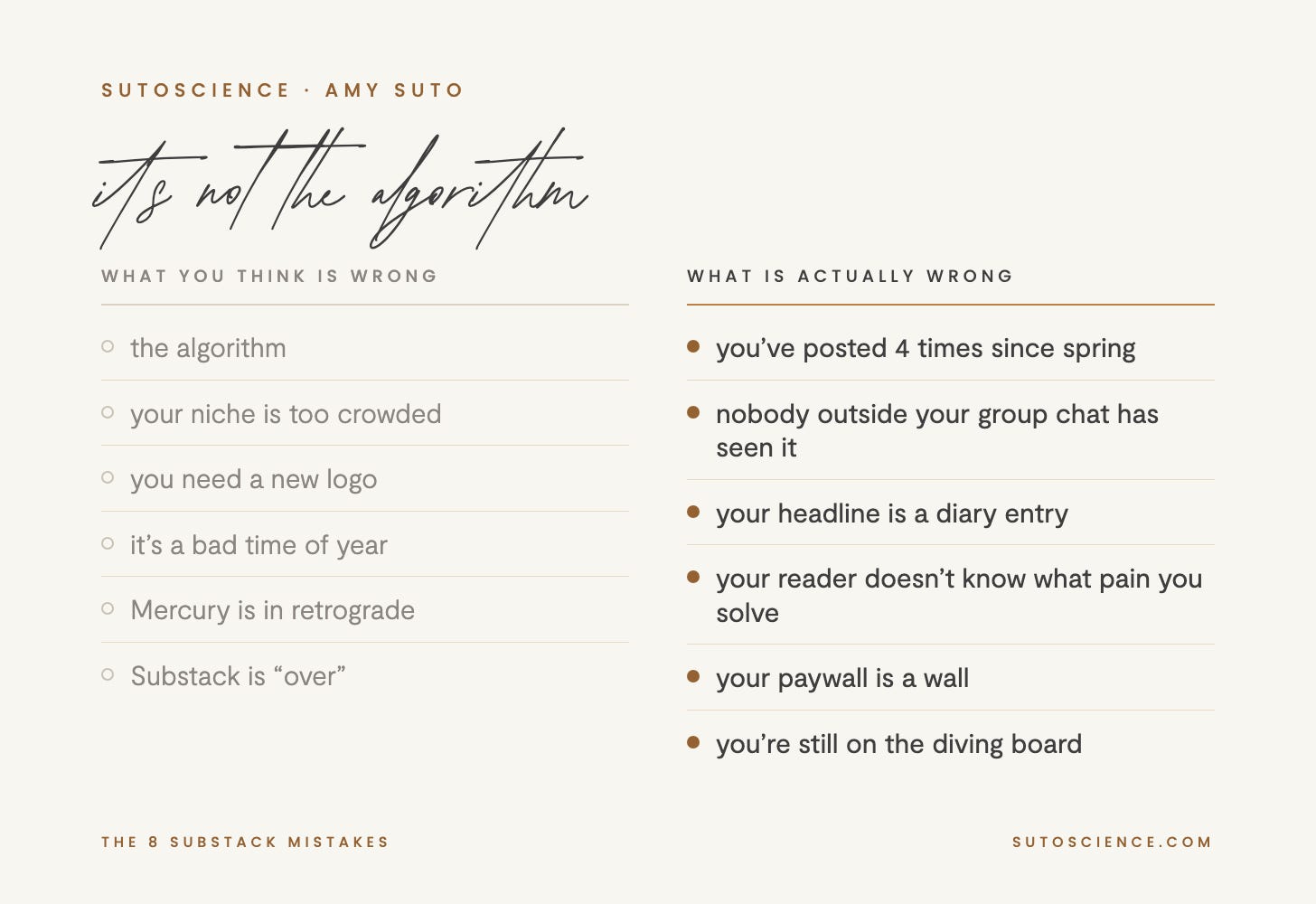
The right column is this post. Let’s dive in.
🏊 Mistake 1: You’re still on the diving board
The most common thing I see in my audits is a Substack that doesn’t exist yet. You’re standing on the diving board. Toes over the edge. You’ve been standing there for 11 months. You have the swimsuit (a gorgeous About page), the goggles (a logo you paid someone on Etsy $40 for), the little towel folded on the chair (a welcome email, drafted, unsent). Below you, the pool is full of writers who are objectively worse at this than you, and they’re doing cannonballs, and they’re having the time of their lives, and lots of them are getting paid for their half-baked ideas.
I know what’s keeping you up there, because it kept me up there. Fear, in a few different outfits. Fear that it has to be perfect. Fear of what your peers will say. Fear that someone from your day job will find it. Fear of the one bad review in a pile of love letters. (I have the love letters. A reader painted me a watercolor for Write for Money and Power. Yet I still think about the mean reviews sometimes.)
Two things got me off the board:
The regret test. Which will you regret more in a year: posting the thing, or not posting the thing? Starting now, or not starting now? Most people regret the things they didn’t do, because doing the thing means you tried and learned something, and not doing it means you have a Notion doc.
Building in public. I’ve been publishing Let Me Be Your Ghost here chapter by chapter as a rough draft. A ROUGH DRAFT. The version you’ve been reading on my Substack is not finished. And it’s been the best thing I’ve done for the book: readers email me what they loved, they found me beta readers, and they were first in line when preorders opened. When I interviewed Brooke Warner of She Writes Press on ✍️ Make Writing Your Job, she told me about authors who query agents for 6 years before they get the yes. 6 years, holding a finished book. Imagine the readers you could reach in 6 years if you put the thing out half-baked and finished baking it with the people who showed up.
You don’t need the name. You don’t need the niche figured out. You don’t need the welcome email. Everything about my Substacks has changed since I started, because that’s the only way anything changes.
You cannot grow a Substack from the diving board. I’ve checked.
🏃♀️ Mistake 2: You’re an intensity person
(I was an intensity person. I understand you! But this will burn you out.)
Brendan O’Meara asked me on the Creative Nonfiction Podcast how to get a stuck Substack moving, and I gave him the most boring answer on the planet: consistency. He cut it into a clip and titled it “The Most Boring Substack Advice You’ll Hear.”
Think about the gym, because it’s the right comparison. When I trained for half marathons, the training was: get up and run, multiple times a week, forever. The cute running clothes were not training. The little pouch of energy gels was not training. Running was training. I say this as someone who tried to cram the whole plan into the last 3 weeks and ran a slow, exhausting half marathon as a result. (I had a good time! I was just slow, and clearly should have been more diligent about a more consistent training plan.)
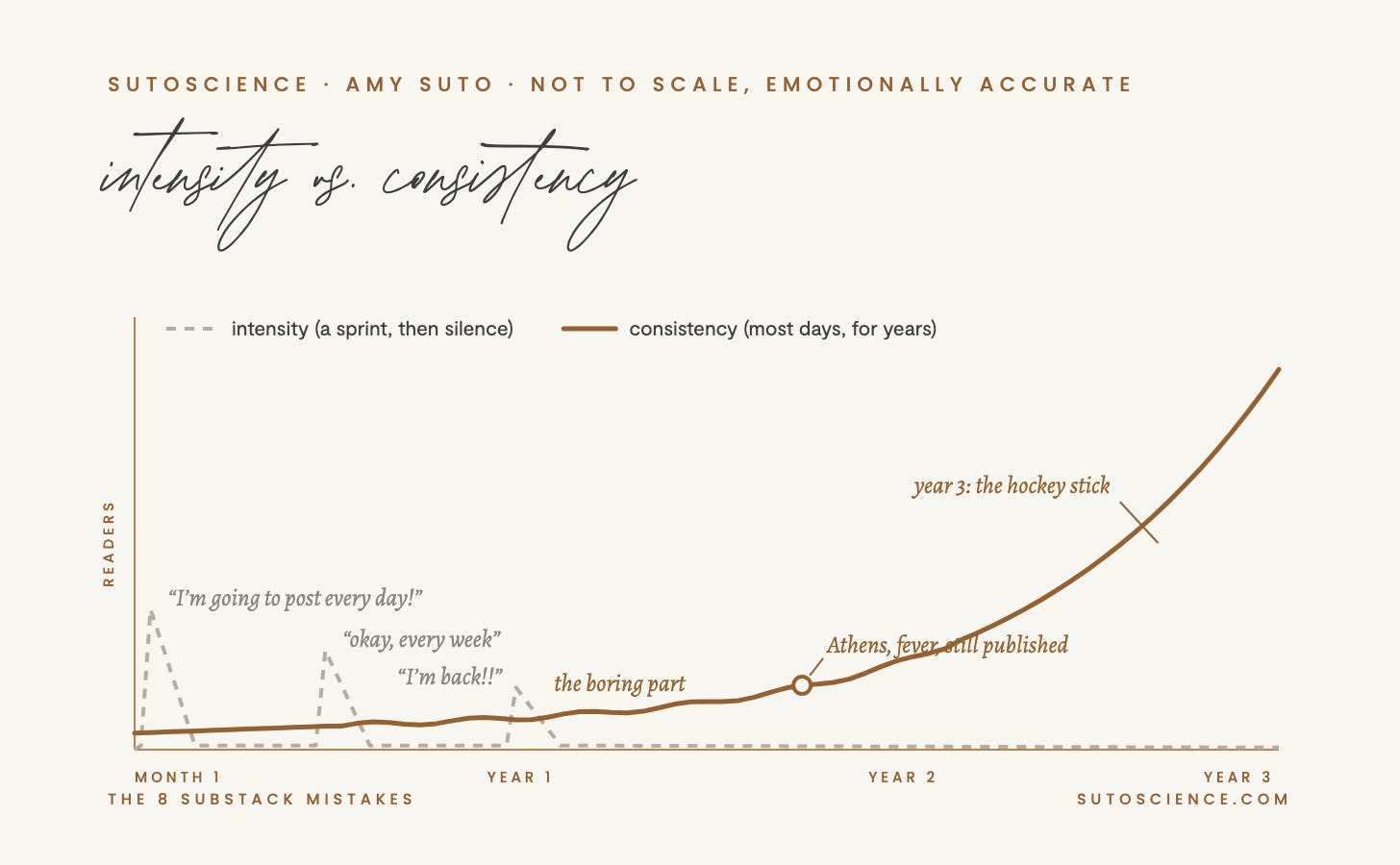
Substack is the same sport. In the beginning, showing up doesn’t compound. Then it does. I declared a $96,000 goal on YouTube in June 2023 with a newsletter making $0, and I posted the whole climb. On YouTube I showed up almost monthly. I missed months, I’m a human woman. But on Substack I never broke the streak: once a week at first, without missing one, then 5 to 7 posts a week on Make Writing Your Job for the last 2 years, with a team now, rain or shine, holidays excepted.
The growth curve went hockey stick right alongside it. 60,000+ subscribers and multiple six figures a year, and the sickest I’ve ever been (Athens, high fever, autoimmune flare, Bachelor in Paradise on the laptop) I still published from the hotel bed. I’m not saying that’s healthy. I’m saying it’s a streak.
National Novel Writing Month taught me this in high school (RIP NaNoWriMo, you were perfect). 1,667 words a day for 30 days and you have a 50,000-word draft. There were days I missed and had to write 10,000 words to catch up. I still got the novel. The goal was never a perfect day. The goal was to write most days.
And I’ll own my version of this mistake, because it’s recent. I did not post a Sunday Tea every Sunday this summer. I got married, I took time off, I read romance novels in bed. 💡 Sutoscience is the Substack I run for joy, and the streak shows it. ✍️ Make Writing Your Job is the one with the 5-day-a-week spine, and it’s the one with the highest revenue. Those two facts are related.
Everything I’ve ever wanted was on the other side of consistency. Intensity got me a nap and a slow half marathon.
🎯 Mistake 3: You don’t know whose pain you’re solving
In an audit a while back, someone told me their target reader was 60-year-olds thinking about doing something creative. Also 30-year-olds figuring it out. Also maybe 20-somethings? I adore this person’s writing, but that’s 3 different letters, and they were trying to mail all 3 in one envelope. If you talk to everybody, you talk to no one. Write the letter to one person, with a face and a name and a backstory, and other people like that person will show up, because people follow writers who are like them in some way.
The easiest reader to write for is a version of you. The you from 3 years ago. The you in the alternate timeline who never figured this stuff out. That’s who most of my posts are for: a younger Amy who needed someone to say the things out loud and save her a lot of heartbreak. It isn’t selfish. It’s a tactical advantage, because you know exactly what she’s stuck on.
Then there’s the part I think most of us forget: the pain point. Think about what makes you click. When we were kids, the nightly news ran “Is Your Deli Meat Trying to Kill You? Details at 11,” and our parents sent us to bed and stayed up for it. I’m not asking you to fear-monger. I’m asking you to know what your reader wants and doesn’t have, and to put that near the top. The posts that do well on this platform almost always name a want, a lack, or a problem with a solution on the way. Or, they’re angled to touch on someone’s deepest thoughts, fears, or desires in a way that’s unsaid but still clear in the positioning.
This is true for fiction, too. Romance novels are doing banging numbers right now because they solve a pain point: loneliness. Human connection, intimacy, and a found family where you get the most powerful man in the kingdom AND his 4 best friends, who are now your friends. Personal essays solve “am I the only one.” Serials solve “what happens next,” which is the oldest pain point there is, and the reason a paywall works in fiction at all.
Pain points are also what turn free readers into paid ones. People upgrade when something hurts and you have the thing.
Which brings me to the part where I show you instead of telling you.
🔐 Okay, watch what I do here
This is the fix for Mistake 7, which I’ll talk about below!
Here’s what’s behind the paywall today:
Mistake 4: why your headline is a diary entry, with a before-and-after cheat sheet and the Substack tool that A/B tests titles for you
Mistake 5: the wrong format for the job (you keep sending essays to someone who wanted a list, or the reverse), including the email I sent from Paris that accidentally became a business
Mistake 6: the readability test, or why people’s eyes stop halfway down your post and what to move
Mistake 7: how to turn your paywall into a landing page (you’re looking at one)
Mistake 8: distribution, the one I’d fix first, and the full version of the hot take about the writers out-earning you
My 20% off codes for the workshop I’m teaching next Tuesday and the course that starts November 1 (Founding Members, your 50% is in there too)
$8 a month gets you all of it, plus every chapter of Let Me Be Your Ghost as it drops.
