

Hey Sutoscientists,
This is Kyle (writer of FounderCore and Amy’s partner in crime) coming in for a special dispatch, guest post here to tell you that if you’re writing on Substack and you haven’t thought about your category… you likely are lighting heaps of money on fire.
Not because Substack is punishing you. But because category is distribution. It’s the “street” you’re setting up shop on.
And in the newsletter economy, traffic is oxygen.
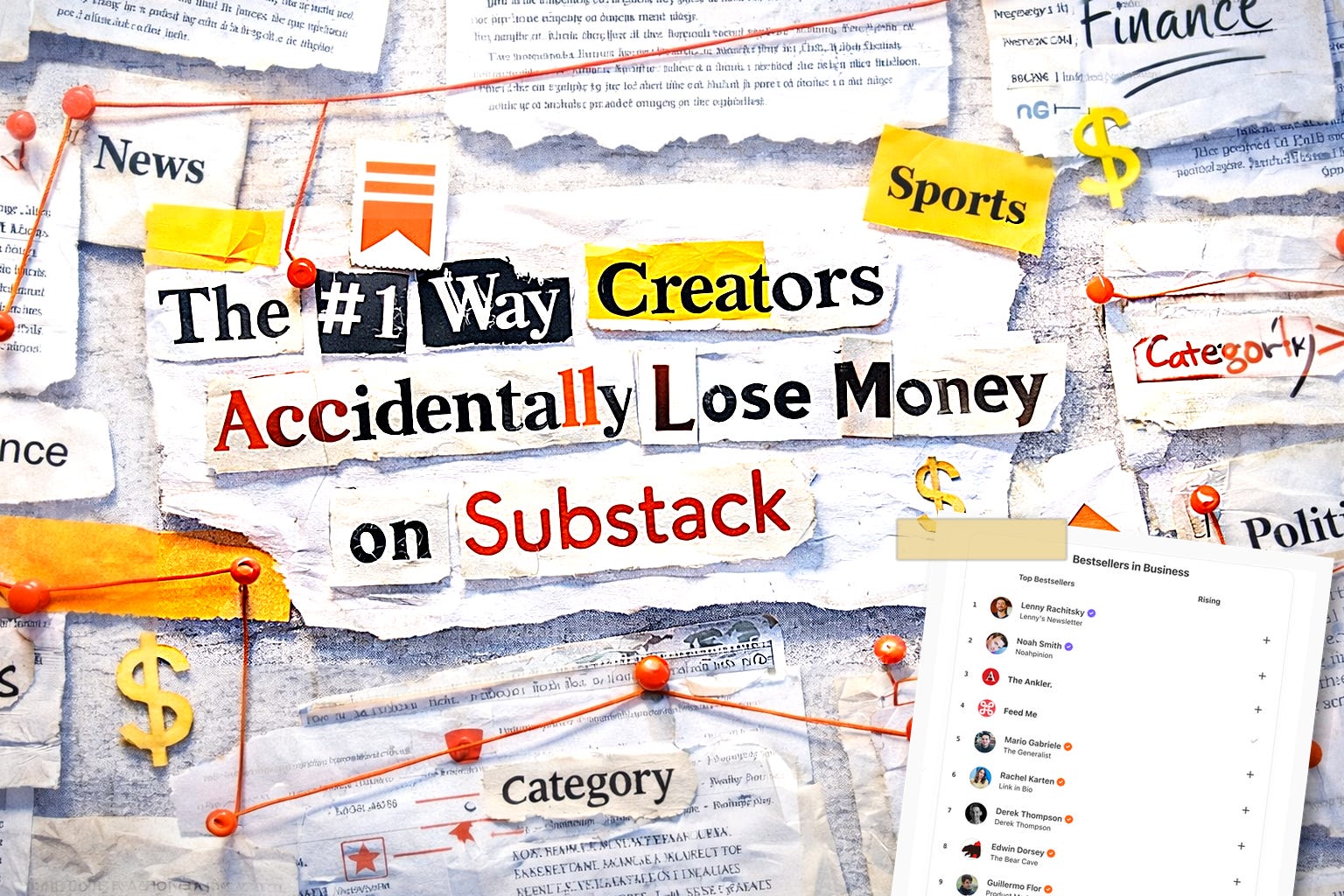
Substack uses categories to help readers discover you (search, explore, recommendations), and your primary category is the one that determines where you show up on category leaderboards and onboarding for new Substackers. That’s not a vibe thing. That’s a routing decision. And, the second category option is like a vestigial tail; unique, but not helpful.
So yes: you can write the greatest newsletter in the world (you might be)… and still be dead on arrival if you’re standing on a street with no foot traffic and hoping someone “just finds you.”
The hard truth: priming someone to pay is brutal
Most of us underestimate how hard it is to get a stranger to pay for words on the internet.
Even if your writing is excellent. Even if you post consistently. Even if your mom says it’s “so you.” (Moms are not a scalable acquisition channel, unfortunately.)
The real game is: are readers already conditioned to pay for this kind of value? Because “paying behavior” is a habit, not a moral stance. People pay for what they’ve been trained to see as worth paying for—what feels like a normal line item in their life.
That’s why some categories feel like pushing a boulder uphill, ask Sisyphus, he seems like the classical example of picking the wrong Substack category. Don’t be him. Don’t be that guy.
Picking the right category should feel like there’s already a conveyor belt of paying customers and you just need to step onto it without falling off.
The Substack wrinkle: categories are a substitute for the audience you don’t have yet
Substack’s origin story (at least the mythological one we all tell each other) is basically: the island of misfit toys for journalists.
A lot of writers left big publications with an existing fan base—readers who already trusted them, already wanted their voice, and honestly were already paying somewhere (newspapers, magazines, memberships) and just followed the person instead of the institution.
If you’re that writer, your category matters… but it’s not life-or-death.
If you’re not that writer (most of us), category becomes your borrowed distribution. It’s one of the few levers you get that nudges you toward “people who are already looking for something like this.”
Big pond vs. small pond isn’t about ego — it’s about your plan
Here’s the strategic choice hiding inside category selection:
If you choose a big pond category (think: places where readers already pay in large numbers), you’re stepping into proven demand. The upside is obvious: you’re selling into a market that already understands subscriptions. The downside is also obvious: you’re standing next to absolute killers who have been publishing for years, and “pretty good” gets ignored.
If you choose a small pond category, you’re not necessarily choosing “worse.” You’re choosing a different job. In smaller ponds, you don’t get as much ambient demand, so you have to create the paying trigger yourself: sharper positioning, clearer promises, off-site sourcing of subscribers, and a paid product that feels like a tool — not a tip jar.
Both paths can work. The mistake is picking a pond and then using the strategy that only works in the other one.
Why politics is a special case (and what to steal from it)
Politics tends to produce big paid newsletters for a few very unsexy reasons:
First: people were already trained to pay for political coverage. Newspapers. Magazines. Opinion columns. TV subscriptions. Politics has lived inside paid media for decades, so the “paying muscle” is already developed.
Second: the stakes are emotionally high and time-sensitive. Politics runs on urgency. It rewards frequency. It punishes “I’ll write when I feel inspired.” A lot of politics readers aren’t paying for “writing.” They’re paying for interpretation and priority: “tell me what matters, tell me what it means, and tell me what to ignore.” That’s an easy subscription decision when the world feels on fire.
Third: politics is identity-adjacent. And identity-adjacent categories are sticky. People don’t just read, they recruit themselves into a worldview, a tribe, a lens. That’s not a judgment. It’s just the psychological reality of why it converts.
Now the important part: you don’t have to write politics to steal the underlying mechanism. The mechanism is “paid clarity.”
The Culture category has its own version of this. We’ve been paying for culture commentary forever: glossy magazines, reviews, gossip columns, and the sacred ritual of reading trash at the grocery checkout line like it’s anthropology. That’s a primed audience too — just pointed at different needs.
Business and finance work because the reader can justify it instantly: “this helps me make money or save time.” That’s basically the cleanest subscription pitch on earth.
So the point isn’t “switch to politics.” The point is: choose a category where the paying habit already exists, closest to what you do, or build a product so obvious it creates the habit.
The mistake to avoid: picking a topic instead of an offer
Most people pick a category like they’re choosing a Hogwarts house: “I’m a Culture writer.” Cool. So what do you do for the reader?
Readers don’t pay for topics. They pay for outcomes.
That’s why the best mental model is: category is how you get discovered, but your offer is how you get paid.
A simple paid promise format that forces clarity:
“I help [specific person] get [specific result] in [timeframe] without [common frustration].”
That’s how “I write about business” turns into “I help freelance writers land two retainer clients in 30 days without posting daily on LinkedIn like a motivational hamster.”
Also: don’t underestimate naming. Most people will give you two seconds of attention. If your publication title doesn’t tell them what they’re about to get, you’re asking them to do homework. And nobody subscribes to homework.
Yes, there are counterexamples. Lenny’s Newsletter is an objectively vague name and it still became enormous — Lenny literally wrote that it hit one million subscribers.
But that’s the point: when the name doesn’t do the work, distribution has to. You need external traffic, a big reputation, strong word-of-mouth loops, or years of compounding.
If you’re earlier, make it easy. “Make Writing Your Job” works because a stranger can instantly think: oh, that’s for me (or not for me). That’s a gift.
And in categories that don’t have a lot of existing paid gravity, like comics, you can still win, but you’ll feel the difference. Brian K. Vaughan has the biggest comics presence on Substack (his profile shows 21K+ subscribers), but there aren’t a million Brian K. Vaughans pouring into that category every week.
The 2-second test (use this before you overthink anything)
Imagine a reader is browsing a category feed with mild curiosity and a short attention span (so… a human).
In two seconds, can they answer:
Who is this for?
What do I get?
Why should I trust you?
If not, your growth isn’t blocked by “writing.” It’s blocked by positioning in the moment of discovery.
Do this today
Pick your top 3 category options and write a one-sentence paid promise for each.
Then ask: which category has the highest chance that the right reader is already browsing there, already primed to pay, and will instantly understand what they’re getting from your title + promise?
Because the best category isn’t the one with the biggest leaderboard. It’s the one where your promise is most believable, most differentiated, and most valuable to the exact reader you want.
…and if you want to see the tally of the categories with the highest amount of paid subscribers flowing through it look here 👇
