

Confession: I used to think SEO was for people who own three monitors… and feel joy when a Chrome extension updates.
(You know the type. They say “top of funnel” like it’s foreplay.)
And then… it quietly became one of the most human tools I’ve ever used.
Because SEO — and now GEO (the way your work shows up inside AI answers) — isn’t really a marketing skill.
It’s a time-protection skill.
It’s how you stop building a business that only works when you’re working.
It’s how you wake up on a random Tuesday and think:
“Oh. The internet is doing its job without me.”
Which is… honestly? The dream.
💻 The Moment It Clicked For Me
I didn’t have some cinematic “aha” moment.
It was more like: I opened my stats, expected nothing, and then stared at my screen like it had just texted me “u up?”
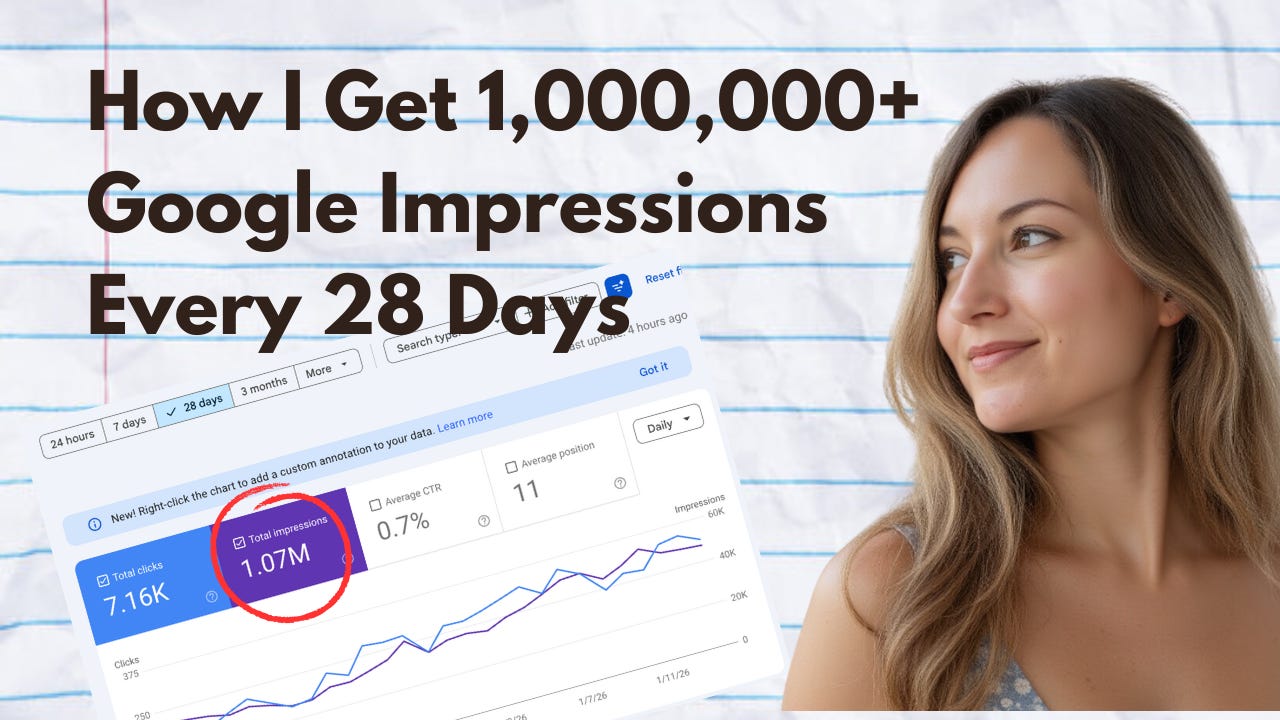
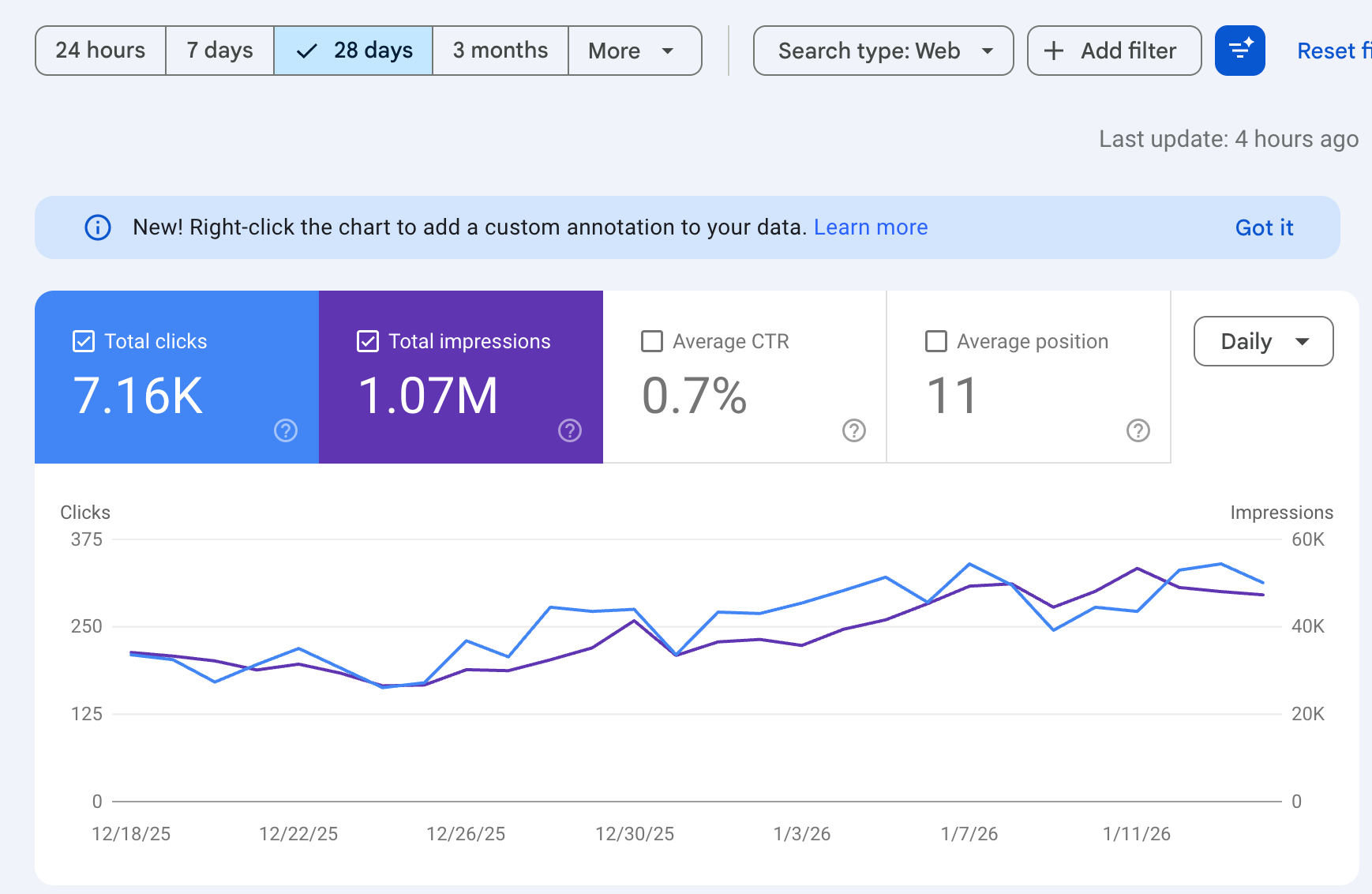
Over the last 28 days, Google showed my content 1.07M times:
1.07M impressions
7.16K clicks
Average position: 11
CTR: 0.7%
And yes, those numbers are nice.
But the real thing that hit me wasn’t “wow, big number.”
It was this:
People were finding my work without me having to be online, charming, productive, or doing my hair.
In fact, I rarely post on my website these days (maybe twice per month?), and still get these kinds of numbers.
That’s the kind of growth that changes your nervous system.
⏰ Section 1: Why Your Time is More Valuable Than You’re Treating It
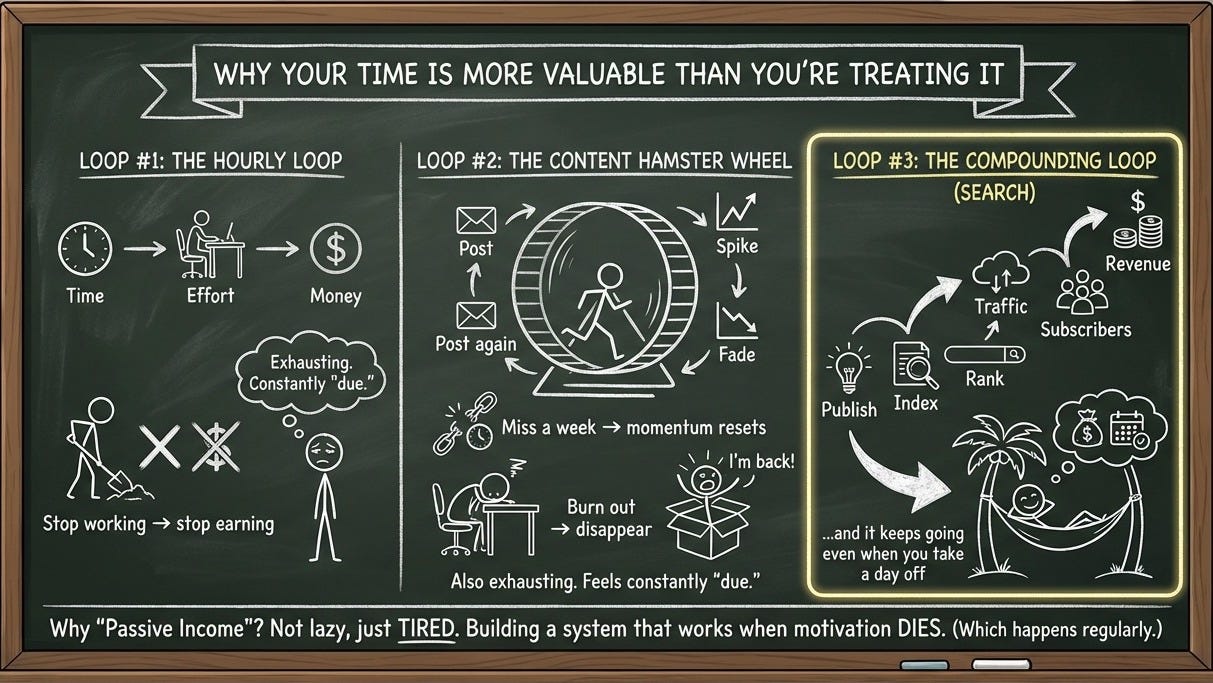
Most creators are stuck in the first two loops:
Loop #1: The Hourly Loop
Time → effort → money
Stop working → stop earning
Loop #2: The Content Hamster Wheel
Post → spike → fade → post again
Miss a week → momentum resets
Burn out → disappear → “I’m back!” (again)
Both loops are exhausting.
Both loops make your life feel like it’s constantly “due.”
Search introduces a third loop — and it’s the one that feels like relief:
Loop #3: The Compounding Loop
Publish → index → rank → traffic → subscribers → revenue
…and it keeps going even when you take a day off.
That’s why people get annoying about “passive income.”
Not because they’re lazy, but because they’re tired. They’re trying to build a system that doesn’t require them to be “on” every day just to survive.
Search is one of the only online channels that can genuinely keep working after your motivation dies.
Which, if you’re human, happens regularly.
🕵️♀️ Section 2: Why Search is Different
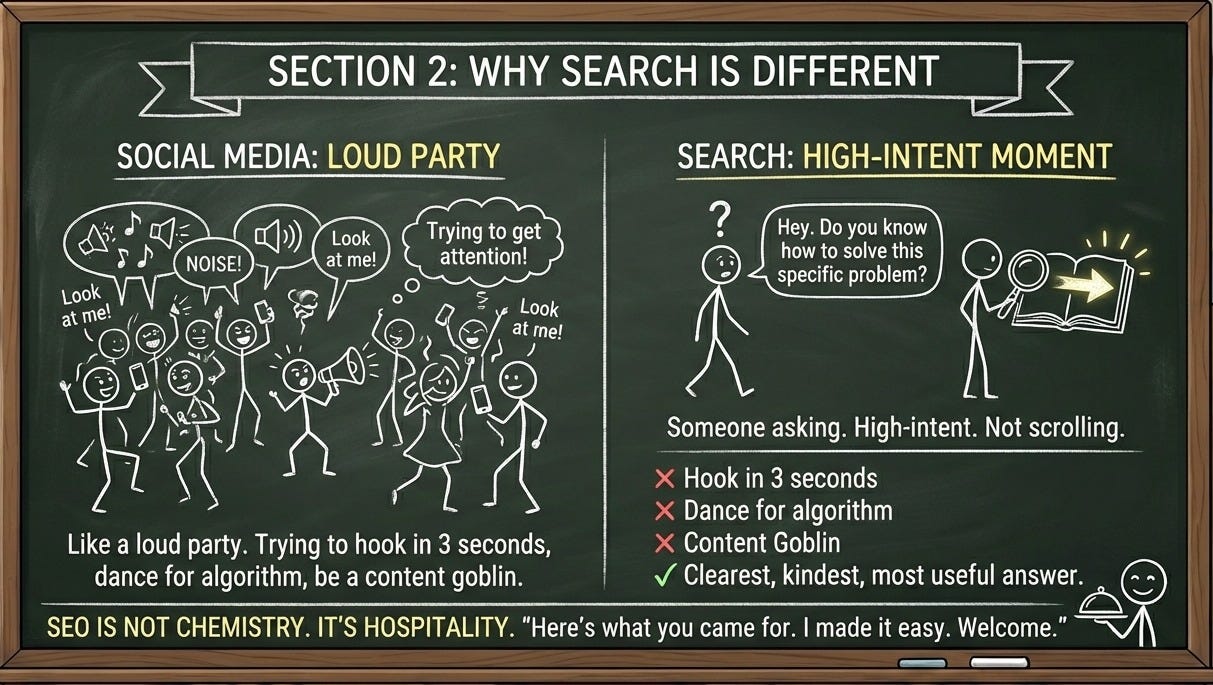
Social media is like trying to get someone’s attention at a loud party. Search is different. Search is someone walking up to you and saying:
“Hey. Do you know how to solve this specific problem?”
That’s a high-intent moment.
They’re not scrolling. They’re asking.
Which means:
you don’t need to “hook” them in 3 seconds
you don’t need to dance for the algorithm
you don’t need to become a content goblin
You just need to be the clearest, kindest, most useful answer.
That’s it.
SEO only feels scary because people explain it like it’s chemistry.
In reality, it’s more like hospitality.
“Here’s what you came for. I made it easy. Welcome.”
💡 Section 3: If You’re Only Posting on Substack, You’re Building a Cute Boutique with No Signage
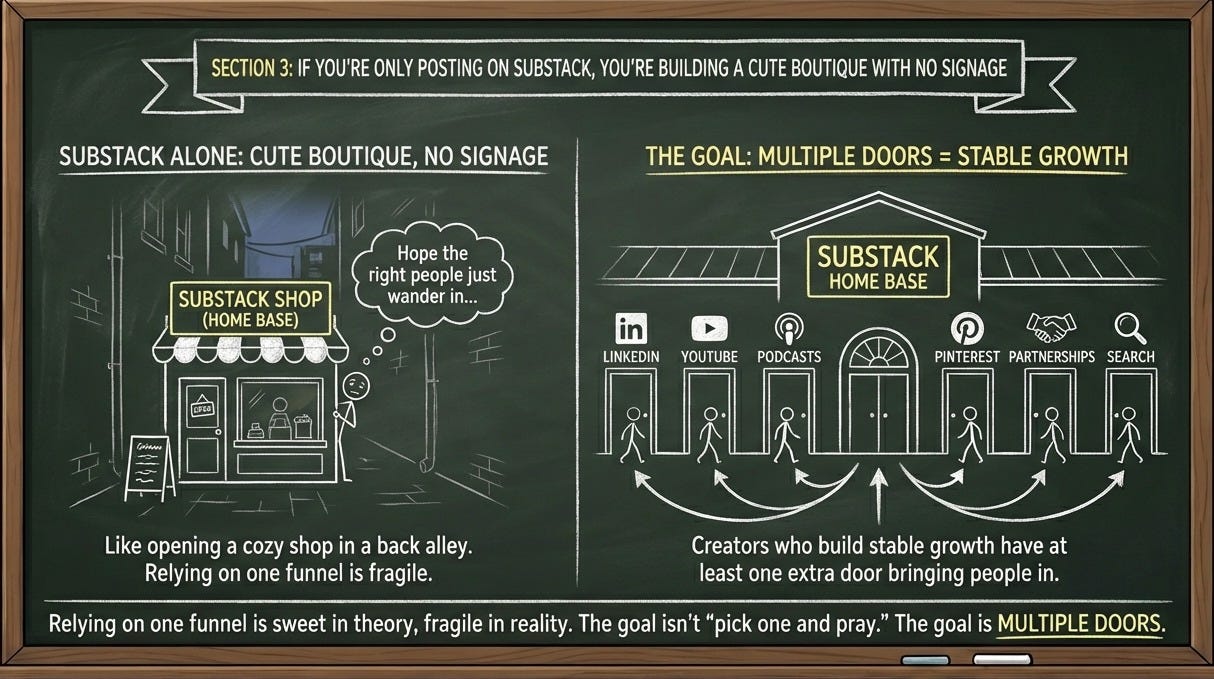
I love Substack. Truly. It’s my home base, but Substack alone is not a complete acquisition engine.
It’s like opening the coziest shop in the world… in a back alley… and hoping the right people just wander in. Substack can absolutely grow you — especially through the Substack Network and its internal growth tools.
But the creators who truly build stable growth? They usually have at least one extra door bringing people in through channels like…
LinkedIn
YouTube
Podcasts
Pinterest
Partnerships
Internet/AI Search
Because relying on one funnel is like relying on one friend to introduce you to everyone you’ll ever meet.
Sweet in theory.
Fragile in reality.
The goal isn’t “pick one platform and pray.”
The goal is: multiple doors.
👩💻 SEO’s Younger Cousin: GEO (aka “Search in Full Sentences”)
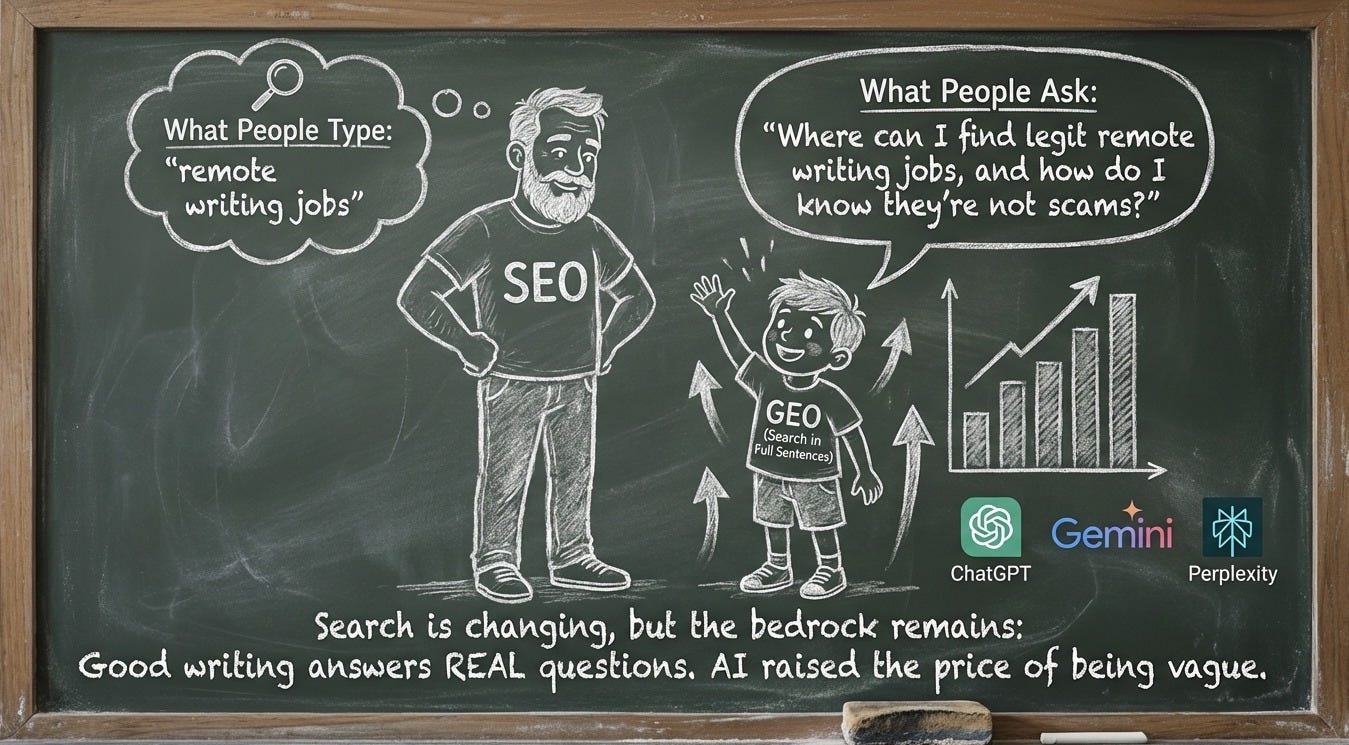
If SEO is “what people type,” GEO is “what people ask.”
Old version (SEO): “remote writing jobs”
New version (GEO): “Where can I find legit remote writing jobs, and how do I know they’re not scams?”
People are still searching. They’re just doing it in ChatGPT, Gemini, Perplexity… wherever. So when someone says “SEO is dead,” what they often mean is: “Search is changing.”
Yes. It is. But the bedrock hasn’t changed:
If you want to be found, you need content that answers real questions.
AI didn’t erase the need for good writing. It raised the price of being vague.
⚡️ My Substack Growth Stats (and The Human Meaning Behind Them)
Here’s what my traffic sources looked like recently behind-the-scenes in my Substack growth dashboard:
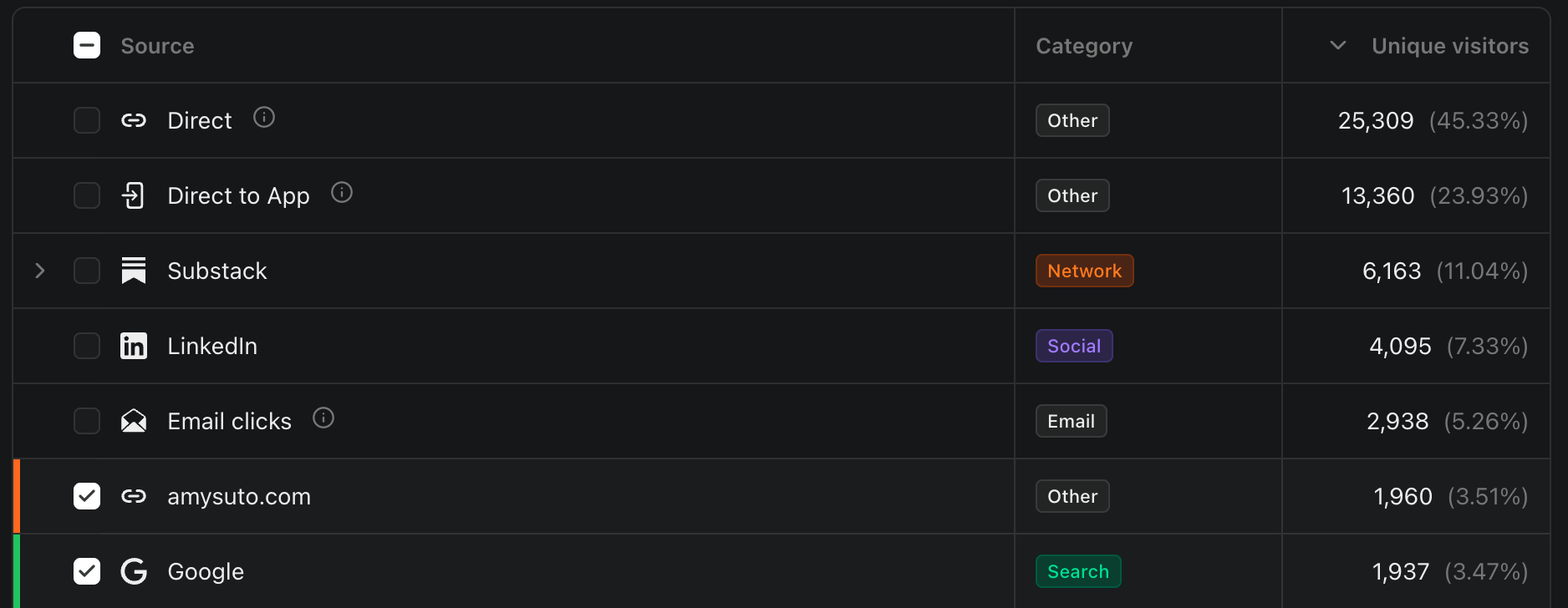
Direct: 25,309 (45.33%)
Direct to App: 13,360 (23.93%)
Substack (Network): 6,163 (11.04%)
LinkedIn: 4,095 (7.33%)
Email clicks: 2,938 (5.26%)
amysuto.com: 1,960 (3.51%)
Google: 1,937 (3.47%)
And new subscribers:
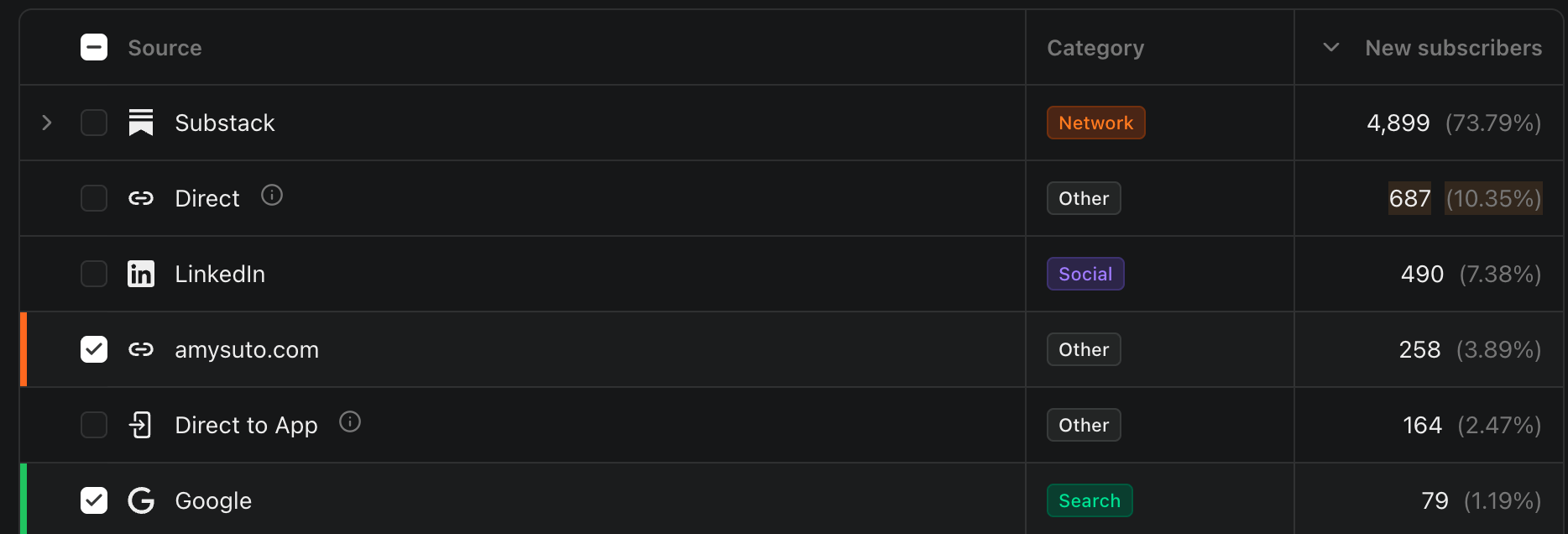
Substack: 4,899 (73.79%)
Direct: 687 (10.35%)
LinkedIn: 490 (7.38%)
amysuto.com: 258 (3.89%)
Direct to App: 164 (2.47%)
Google: 79 (1.19%)
If you’re looking at this thinking, “Google is small compared to Substack,” yes.
And also:
Google is the channel that compounds the longest.
Substack’s network can spike you.
Google can quietly feed you forever.
You want both.
Because spikes are exciting.
But “quietly feeding you forever” is the thing that makes you feel safe.
🏡 Substack is the Relationship. Your Site is the Welcome Mat.

Here’s the simplest way I can explain what changed everything for me:
Content is the asset that compounds.
Substack is where the relationship deepens.
Substack is the living room.
Your blog/website is the welcome mat.
And in my experience, Substack doesn’t always index as cleanly for evergreen search the way a personal site does. Substack behaves like a newsletter ecosystem — weekly cadence, natural half-life.
For evergreen search?
A personal site is often a cleaner container for Google (and now AI tools) to understand and reward.
So if you’re serious about longevity, I recommend:
Substack = relationship + community + monetization
Website/blog = indexing + search + long-tail discovery
🙌 Where to Start (Without Turning into a Full-Time “Marketing Person”)
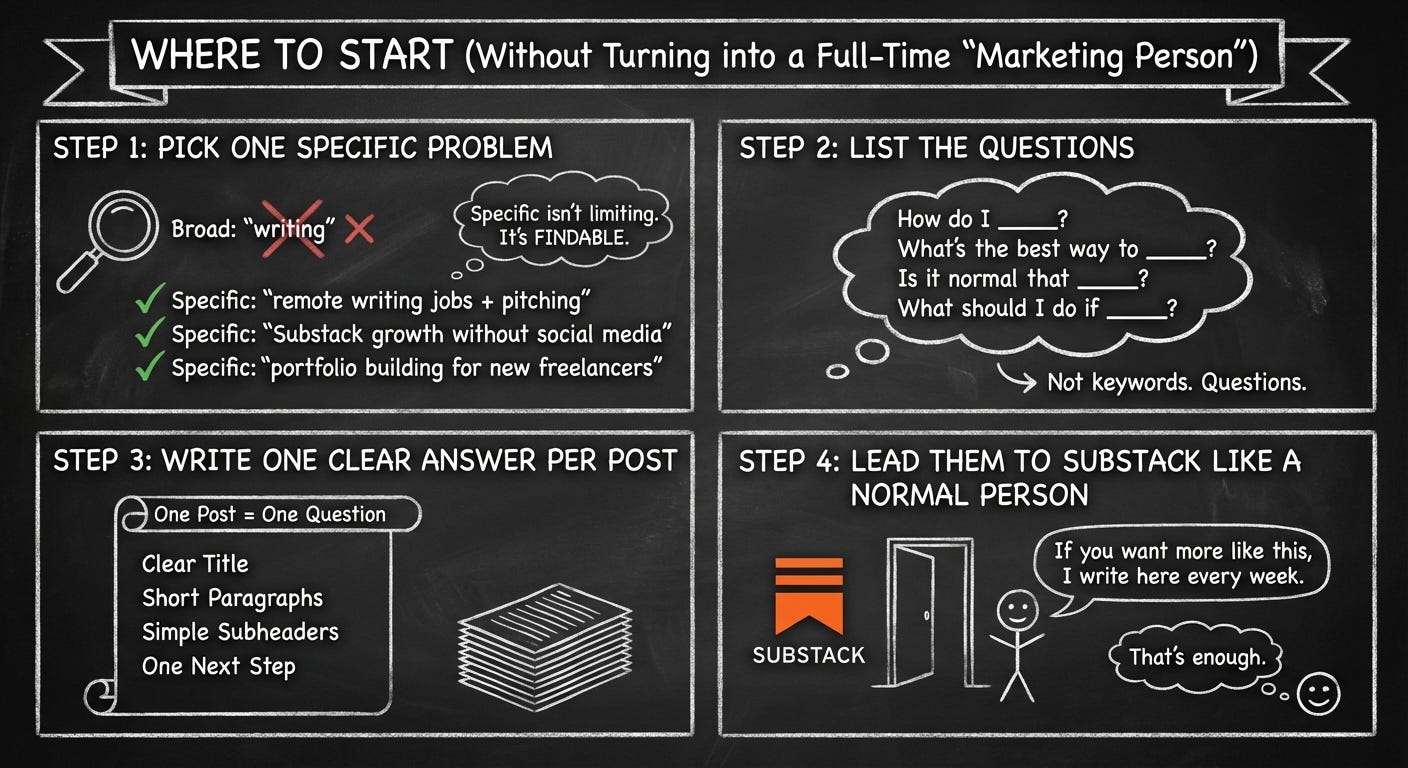
Step 1: Pick One Specific Problem You Solve
Specific is key here!
Broad: “writing”
Specific: “remote writing jobs + pitching”
Specific: “Substack growth without social media”
Specific: “portfolio building for new freelancers”
Step 2: List the Questions Your Audience Already Asks
Not just keywords. Questions.
“How do I ____?”
“What’s the best way to ____?”
“Is it normal that ____?”
“What should I do if ____?”
Step 3: Write One Clear Answer Per Post
One post = one question.
Use:
a clear title
short paragraphs
simple subheaders
one next step
Step 4: Lead Them to Substack Like a Normal Person
A soft line at the end:
“If you want more like this, I write here every week.”
That’s enough — you don’t have to get fancy or pushy with your call-to-action.
✍️ If You Want Me to Teach You How to Build Traffic Like This Step-By-Step With Customized Support…

After I finish leading the rest of our 6 Week Substack Sprint, I’ll then be sharing a new workshop series on SEO + GEO for Substack creators — something that makes this feel simple, doable, and (importantly) not like you need to become a full-time marketing person.
If you’re interested, be sure to upgrade to Founding Member here at Sutoscience, as the live classes and workshop materials will only be available to Founding Members. The price is going up this week, so get in before it increases!
And if you want the LinkedIn funnel breakdown too (because yes, it’s another major door), tell me — I’ll write that next.
Because you deserve a system that supports your life.
Not one that consumes it.
-Amy
Thanks, Amy! Would love to see your take on LinkedIn!
So excited for the SEO + GEO classes!